
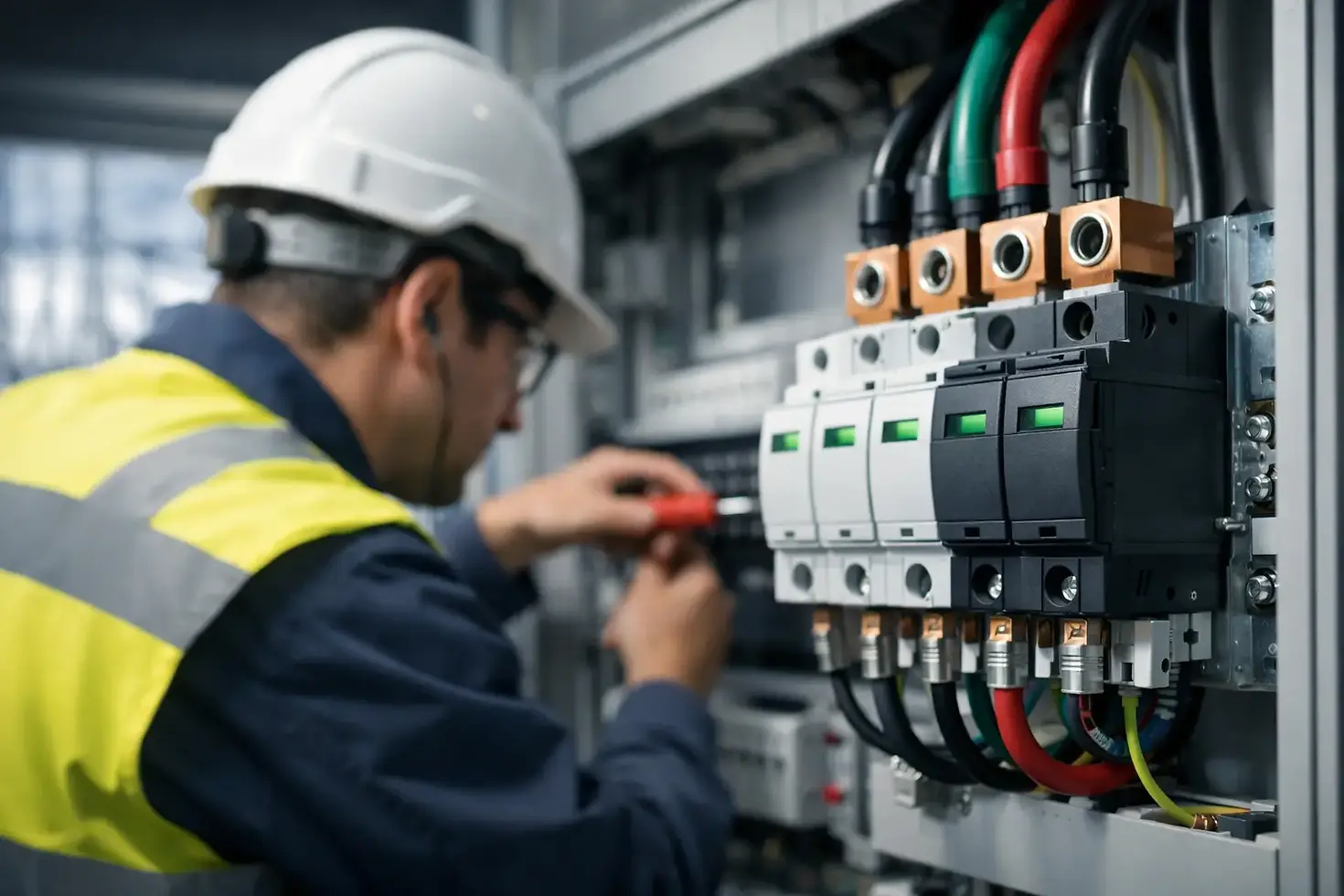
Commercial Surge Protection for Critical Sites

A failed drive, alarm panel or network switch rarely announces itself as a surge issue. It simply stops working, interrupts an operation and leaves the responsible person arranging a replacement under pressure. Commercial surge protection is designed to limit that risk by diverting transient overvoltages safely to earth before they reach sensitive equipment.
For facilities managers, property managers and project leads, the objective is not merely to fit a device in a distribution board. It is to protect continuity of service, support electrical compliance and make sure a fault does not turn into avoidable downtime.
What surge protection is designed to prevent
A surge is a short, sharp increase in voltage. It can be caused externally by lightning activity or switching on the electricity network, but many surges originate within the building itself. Large motors, lifts, air conditioning plant, variable-speed drives, welding equipment and switching contactors can all create transient voltages as loads start and stop.
These events may last only microseconds, but modern commercial equipment is increasingly sensitive. Building management systems, fire alarm controls, access control, CCTV, data equipment, LED lighting drivers, EV charging equipment and production controls all contain electronic components that can be damaged or gradually degraded by repeated exposure.
The consequences are not limited to the cost of one replacement part. A surge can create intermittent faults that are difficult to trace, take down a critical system outside working hours or compromise equipment that has not yet reached the end of its expected life. Where a site relies on connected systems to operate safely, the operational impact can quickly outweigh the initial cost of protection.
When commercial surge protection is needed
Surge protection requirements should be considered as part of the electrical design, installation and inspection process. BS 7671 requires protection against transient overvoltages where the consequences could affect human life, public services, commercial or industrial activity, a large number of people, or significant cultural assets. In other circumstances, a risk assessment may determine whether protection is required.
For most commercial premises, the practical question is straightforward: what happens if an electrical surge damages a key system? If the answer involves lost trading, site closure, safety concerns, missed production, failed communications or significant replacement costs, surge protection should form part of the plan.
It is particularly relevant for:
offices with server rooms, network cabinets and connected building controls
industrial sites using automation, drives, plant controls or process equipment
retail, hospitality and leisure locations dependent on payment systems, refrigeration or security systems
healthcare, education and public-facing premises where system availability affects users
construction sites with temporary supplies, welfare units, site offices and valuable equipment
commercial properties with solar PV, EV chargers, lightning protection systems or exposed overhead supplies
The correct approach depends on the installation. A small office supplied from a modern internal intake will not have the same exposure as a large industrial site, a rural property with an overhead line supply or a building fitted with an external lightning protection system.
The main types of surge protection device
Surge protection devices, often referred to as SPDs, are selected according to the nature of the incoming supply and the level of protection required. They are not interchangeable add-ons.
Type 1 protection
Type 1 SPDs are intended to manage high-energy surge currents, including those associated with a direct or nearby lightning event where the installation is connected to an external lightning protection system. They are generally installed at the origin of the electrical installation, close to the main intake.
These devices are important where lightning current may be conducted into the electrical system. They are not a substitute for a correctly designed lightning protection system, nor does their presence remove the need for proper earthing and bonding.
Type 2 protection
Type 2 SPDs are the most common form of commercial protection. Installed at the main distribution board or relevant sub-distribution boards, they reduce switching and induced surges to a level that most connected equipment can tolerate.
For many business sites, Type 2 protection is the essential starting point. However, it must be selected for the system characteristics, fault level and installation arrangement, then installed in accordance with the manufacturer's requirements.
Type 3 protection
Type 3 SPDs provide additional local protection for particularly sensitive equipment. They may be used close to critical controls, IT hardware or other electronic loads after Type 1 or Type 2 protection has been installed upstream.
This layered approach matters. A single device at the intake may reduce the main surge, but cable length and induced voltages can still leave sensitive equipment exposed elsewhere in the building. Coordination between devices is therefore a design issue, not an afterthought.
Location, cable length and earthing matter
An SPD only performs as expected when it is correctly installed. The connection conductors between the device, live conductors and earth should be as short and direct as practical. Excessive cable length increases voltage drop during a surge and reduces the protection available to downstream equipment.
The condition of the earthing and bonding arrangement is equally important. Surge energy needs a safe path to earth. Deficiencies in earthing, bonding or the distribution arrangement can affect both protection performance and overall electrical safety.
This is why surge protection should be assessed alongside the wider installation rather than treated as a standalone item. During a new installation, alteration, consumer unit or distribution board replacement, the contractor should consider the supply characteristics, earthing system, existing protective devices, prospective fault current, connected equipment and future load plans.
For multi-let properties and larger sites, a coordinated arrangement may be needed across the main intake, submains and local boards. Protecting one board while leaving essential systems fed from another board unprotected can create a false sense of security.
Do not overlook data, telecoms and external circuits
Mains power is not the only route for surge damage. Data cabling, telephone lines, aerial feeds, CCTV circuits, gate controls, fire alarm interfaces and external sensors can introduce transient voltages into connected equipment.
A well-considered scheme identifies all conductive routes into a critical system. For example, protecting the mains supply to a CCTV recorder but not the external camera cabling may leave the recorder exposed. The same applies to networked controls, solar PV monitoring equipment and EV charging communications.
Protection on these circuits must be compatible with the signal type and equipment specification. Fitting the wrong device can impair performance, create communication faults or void manufacturer requirements. This work needs proper design and verification, especially where life-safety or security systems are involved.
Inspection, maintenance and documentation
SPDs are not fit-and-forget devices. Many include a visual status indicator that shows whether the protective element remains operational. Some provide remote signalling so a building management system can report when replacement is required.
Visual checks should form part of planned preventative maintenance, particularly after known electrical disturbances, local lightning activity or a supply event. The device may need replacement after absorbing a significant surge, even where the rest of the installation appears to be operating normally.
During an Electrical Installation Condition Report, the inspector should consider the presence, suitability and condition of surge protection where applicable. Clear reporting helps the dutyholder understand whether a recommendation relates to compliance, resilience or both. It also provides a record of what has been installed, where it is located and when it was last checked.
For landlords, managing agents and organisations with multiple sites, this documentation is valuable. It supports consistent maintenance planning and avoids relying on assumptions when a board is altered, equipment is added or responsibility changes hands.
Common mistakes that leave sites exposed
The most common error is treating surge protection as a box-ticking exercise. A device may be present, but incorrectly rated, poorly connected, isolated from key circuits or no longer operational.
Another frequent issue is protecting the incoming mains supply while overlooking external circuits and sensitive equipment further downstream. This is especially relevant where buildings have remote plant, gate systems, rooftop equipment, EV chargers or solar installations.
Cost also needs to be viewed in context. The cheapest SPD is not necessarily suitable for the installation, and the cost of a correctly designed arrangement should be weighed against lost productivity, emergency call-outs, damaged equipment and delayed operations. The right level of protection depends on the site, but doing nothing is rarely a neutral decision.
Building surge protection into planned works
The most efficient time to review surge protection is before disruption is already happening. Include it when planning distribution board upgrades, electrical remedial works, EV charging installations, solar projects, landlord improvement works or new commercial fit-outs.
A competent contractor can assess the installation, identify the systems that need priority protection and specify devices that work with the existing electrical infrastructure. The work should be tested, labelled and documented, with certification and clear information for the person responsible for the site.
M Howe Electrical Services supports commercial clients with compliant electrical installations, remedial works and planned maintenance across Sheffield and the UK. For a site with critical systems, a practical review of surge exposure can prevent a small electrical event becoming an operational problem at the worst possible time.


Comments